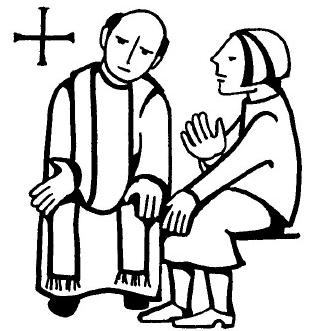
Lent is a good time to do a Spiritual health check, Confession (or Reconciliation) can be a helpful part of that process. There are times in our lives when things we do (or don’t do) block us from growing spiritually. They stand between us and God and we can’t get around them. Confession is a way of removing the barriers that grow between us and God, that stop us from growing spiritually. Confession and absolution can be a liberating way of reconnecting with God and make us more effective and stronger in our lives of Christian service and witness. You can read more and find a standard form for confession and absolution in the Church in Wales by following this link: https://allsaintsandholytrinity.co.uk/reconciliation/
Fr Dylan is available by appointment for anyone who would like to make use of this ministry over Lent. You are welcome to get in touch to know more or follow this link to book a time to meet for this purpose https://cal.com/frdylan/reconciliation
The tradition of Lent is linked to Jesus’ fasting and temptation in the desert before beginning His ministry. The tradition has evolved from the preparation of new believers to be baptised at the Easter vigil, but by the 4th century it was extended to a preparation for all.
I like preparing for things, being ready – having all I need, knowing what is required of me, so in order to prepare for Lent I find myself reflecting on Easter. The Liturgical year takes us on a journey through our faith drawing our focus to different aspects of it at different times. Easter is the pinnacle and cornerstone of our faith, we remember the death and resurrection of Jesus and the new life we find in Christ. The basic tenant of the Christian faith is that Christ’s death and resurrection we (who ever we are) are restored as God’s children.
In his letter to the Ephesians, Paul describes salvation very clearly as God’s doing not ours.
But God, who is rich in mercy, out of the great love with which he loved us even when we were dead through our trespasses, made us alive together with Christ—by grace you have been saved— and raised us up with him and seated us with him in the heavenly places in Christ Jesus, so that in the ages to come he might show the immeasurable riches of his grace in kindness towards us in Christ Jesus. For by grace you have been saved through faith, and this is not your own doing; it is the gift of God— not the result of works, so that no one may boast.
Preparation?
The fact is that at Easter we celebrate and remember the gift of salvation for all that none could earn. So how on earth do you prepare for that?
So Lent is not about giving up the things we think are bad for us anyway, or about punishing ourselves for not being good enough, or about trying to earn our salvation by chalking up points. Lent is about coming face to face with who we are in Christ, loved, forgiven, children of God called to be loving and forgiving.
Lent is a time of preparation for Easter, not to earn our salvation but to realise that we cannot. In the Liturgical year Lent is the time that we strive put aside all that gets in the way of our holding firm to our being who we are in Christ. Lent is like a spring clean for the soul, firmly avowed that we won’t let it get that messy again, but knowing that we probably will.
Lent is about preparing, it is also about journeying towards Easter, learning again and again to let go of those things we grasp so tightly so that we can receive open handed and open hearted of God’s love and grace through the death and resurrection of Christ.
The three challenges of Lent
Lent is a time for us to change our lives and grow in holiness. Through the three challenges Lent gives us – fasting (giving up), almsgiving (giving to others) and prayer, we work on developing a closer relationship to God. Our 40 days should be filled with reflection, service and spending time with God in prayer.
Fasting – this might mean giving up a particular food, fasting from meals, or activities – like watching TV or social media, or other things. When preparing the important questions to ask are:
How are the things I want to give up going to help me develop a closer relationship with God?
Will my fast encourage me to avoid sin?
Will abstaining from these activities lead me to become a more faith-filled person?
Giving – This usually brings money to mind, and Lent is always a good time to review how we use what we have and perhaps give money to church, charity, or someone personally. However, giving is also about how we use our time and all the gifts God has given to us.
Prayer – If you don’t have a daily pattern of prayer, Lent is a great time to try it, or develop one if you do. There are a great deal of different ways to pray and resources to help. The most important things to remember are:
Habits take time and work to develop
God isn’t going to judge your prayer, God will be overjoyed that you prayed!
Events in the Mission Area this Lent?
St Margaret’s, St Mark’s and St John’s Wednesday Evenings 12th March- 9th April: 7pm for 7.15pm. A Lent study based on John’s Gospel at St Margaret’s Church, Garden Village. LL11 2SH
St Giles’
Lent course from 1300 – 1415 every Thursday (not Maundy Thursday. This year’s course has been compiled by Catherine Jackson one of the congregation – looking at the poetry of Gerard Manley Hopkins.
Fridays 3pm (not 20/2 or Good Friday)
Stations of the Cross at 3pm.
All Saints’ and Holy Trinity
Friday 12:15, All Saints – The Chosen Season 5. Join us to watch the fifth season of The Chosen and think about the Last Supper and the events of Holy Week.
Midweek Communion in the Mission Area Tuesday 10:30am, All Saints, Poyser St Wednesday 10am, St John’s, Rhosnesni Wednesday 11am, St Margarets, Garden Village Thursday 11am, St Giles Friday 2pm, All Saints (Yn Gymraeg)
The last week of Advent is marked by the O Antiphons, the liturgical crossover between Advent and Christmas. The emphasis moves from the expectation of the coming of Christ at the end of time to the expectation of the birth of a babe in Bethlehem. These antiphons have been used differently in different traditions through the ages but are commonly used during Evening Prayer with the Magnificat – the Song of Mary.
I love Advent and and always one of the first to start whining about how Advent gets lost in the preparation for Christmas. There is something about Advent that reminds us that as Christians we live in-between worlds, the was, the is to come and the now. The secular season of christmas that runs parallel to Advent, and is done pretty much before the Liturgical season of Christmas has begun, is a stark reminder of the bi-cultural world most Christians find themselves inhabiting. One that Advent actually helps us to reflect upon and live out authentically.
Thorns take the shape of a crown. Popular acclaim turns to public execution. Sorrow and love flow mingled down. Life ends and begins.
Holy Week tells a story like no other, a powerful story of change—a story that continues to change the world, and to change people’s lives.
It’s possible to fast-forward to the great celebration of Easter and hear only the story of joy that came on that resurrection morning. But the impact, indeed the change, is deeper and more powerful when we walk through these holy days together.
We begin with the power of the triumphal entry with the Liturgy of Palms on Palm Sunday.
We join the disciples gathered for the last supper on Maundy Thursday and discover something about what it means to serve.
Come and see for yourself what’s ‘good’ about Good Friday.
Catch the first rays of hope on Easter Day.
Holy Week celebrations are marked with honesty. The measured pace of the week helps us to absorb the intense meaning of the events being celebrated. Life, of course, cannot be put on hold—but this week, above all others, is an invitation to pause and reflect on the gifts of faith and community.
You can simply attend Palm Sunday and Easter, but you are deeply encouraged to make time to enter deeply into the entirety of the liturgy of Holy Week as described below. This guide to Holy Week is offered as a way to encourage you to find your own path through these important days.
You may find more than you can ask for or imagine.
Palm Sunday, April 13th
9:30am Holy Trinity 11am All Saints Liturgy of the Palms and the Passion
Join us in the celebration of Jesus’ triumphal entry into Jerusalem as we process around the church with palms and sing “Hosanna!” Begin the drama of Holy Week as we recount the story of the crowds who welcomed Jesus, only to turn on him a few days later.
Mondayof Holy Week, April 14th
10am-4pm – All Saints, Hands-on Holy Week 6pm – All Saints, Eucharist and reflection
Tuesday of Holy Week, April 15th
6pm – All Saints, Eucharist and reflection
Wednesday of Holy Week, April 16th
6pm – All Saints, Eucharist and reflection
Maundy Thursday, April 17th
7pm All Saints Washing of Feet, Celebration of Eucharist, the Watch
We gather to hear the story of the Last Supper and the giving of the New Commandment to love and serve one another. Anyone who wishes is invited to come forward to have their feet washed as a sign of service. The Holy Eucharist—our weekly memorial of the Last Supper—is celebrated, and then the altars are stripped of their linens and the ornaments of the church are removed, leaving a stark and bare worship space. We are then invited to keep watch:
“Could you not stay awake with me for one hour?”
Maundy Thursday night we remember Christ’s agony as he was betrayed in the garden of Gethsemane. We will keep a watch from 8:30pm until midnight, finishing with compline at 11:45pm. It is common for people to watch for a short time, or to go and come back, some might stay for the whole time. Join us in this longstanding tradition of keeping watch with Christ. Jesus said to them, “My soul is overwhelmed with sorrow…stay here and keep watch with me.
Good Friday, April 18th
12 Noon – 3pm – Holy Trinity, the three hours
Good Friday is the day we commemorate the death of Jesus. We remember his brutal death on the cross, the humiliating punishment favoured by the Romans for seditious and unsavoury criminals. This liturgy is solemn and penitential, but it is still a celebration because we know that through the cross of Jesus our sins are washed away and we are freed from our guilt. Through the outpouring of the love of Jesus on the cross, we claim our inheritance as children of God. The three hours devotion is broken up into three parts. You are welcome to join at any point.
12pm – Stations of the cross
1pm – Reflections
2pm Liturgy of the Passion of our Lord
Walk with Jesus to the cross using the tradition of the Stations of the Cross, with readings, reflections, and quiet hymns. Spend some time in personal quiet reflection. Join with the liturgy of the day, when we hear again the Passion, Jesus’ suffering and death and give thanks for his love and sacrifice. We leave in silence, broken-hearted because he died for us, but, our broken heats are still full of hope because He Lives.
Holy Saturday, April 19th
The Church waits in silence as Jesus lies in the grave.
Mission Area Easter Vigil, Holy Trinity, 8pm
We join with the Mission Area to celebrate the Ressurection. Beginning with the kindling of the New Fire, from which is lit the Paschal Candle – the sign of the risen Christ. The candle is processed into the church and the ancient Easter proclamation “Exsultet” is chanted. We then recount the story of salvation, remembering how God is at work in human history. The Gospel of the Resurrection is proclaimed and we celebrate Eucharist together, sharing in the new life of the risen Lord.
Easter Sunday, April 20th
9:30am Holy Trinity 11am – All Saints
Easter Sunday – Eucharist of the Resurrection
Easter Day is the greatest celebration in the entire year of the Church: the celebration of Jesus’ resurrection and, through God’s raising up of Jesus, the promise of new life for the Creation. In God all things are made new, and we celebrate this with great joy and happiness on the day of Resurrection. After a long season of Lent with no flowers or alleluias, the church is decorated with bright flowers—a sign of the Resurrection—and “Alleluia!” rings out in joyful praise of our God who raised Jesus from the dead.
Mothering Sunday, or Refreshment Sunday are names given to the fourth Sunday of Lent. In the 16th century the practise of returning to the church one was Christened at, or the main church in the area (mother church) began and in the 17th century this expanded with with servants given the day off to visit their families. It developed over time into a time for family reunions and honouring mothers.
Today it is a day of many meanings. It’s a time to honour our mother church, reflect on our love for our earthly mothers, and for some, to celebrate Mary, the mother of Jesus. Lately, it has also become a moment to appreciate the beauty of Mother Earth.
For many, it’s a day filled with love, gratitude, and warmth. Yet, others may find it a little bittersweet, facing a mix of feelings like regret and loneliness. Whatever it means to you, may this day bring a sense of connection and understanding and know that you are held in prayer.
1 At that very time there were some present who told him about the Galileans whose blood Pilate had mingled with their sacrifices. 2 He asked them, ‘Do you think that because these Galileans suffered in this way they were worse sinners than all other Galileans? 3 No, I tell you; but unless you repent, you will all perish as they did. 4 Or those eighteen who were killed when the tower of Siloam fell on them—do you think that they were worse offenders than all the others living in Jerusalem? 5 No, I tell you; but unless you repent, you will all perish just as they did.’
The Parable of the Barren Fig Tree
6 Then he told this parable: ‘A man had a fig tree planted in his vineyard; and he came looking for fruit on it and found none. 7 So he said to the gardener, “See here! For three years I have come looking for fruit on this fig tree, and still I find none. Cut it down! Why should it be wasting the soil?” 8 He replied, “Sir, let it alone for one more year, until I dig round it and put manure on it. 9 If it bears fruit next year, well and good; but if not, you can cut it down.” ’
Bell tolled
Priest robed
Gospel read
Creed said
All moves in harmony
Harmony of liturgy
But what is that to me?
I cannot look on crucifix or priest,
And the eyes of my friends accuse.
Faltering, I take the Host.
Wormwood and gall I remember
Pulsing life given for me.
I drink wine, red as the blood
That flowed from my Saviour’s side.
Hope renewed
Faith restored
Grace given
Christ received.